
Champion Farms
Home »
Champion Farms
Clarkston, Utah
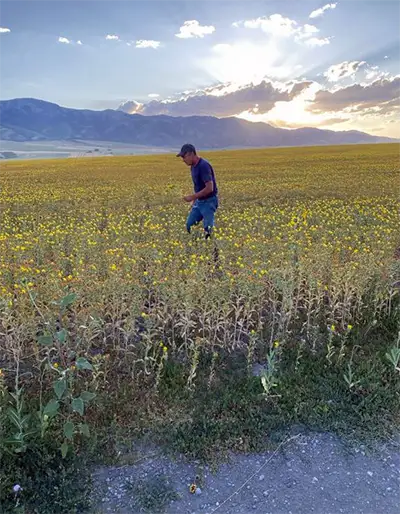 Champion Farms is a dry farming operation which includes wheat and safflower crops on 242 acres in Clarkston, Utah. These two crops are rotated annually for maintenance of soil health. This land is part of a generational family farm currently farmed by Christian Ravsten who proudly claims that the land has been under the Ravsten family ownership for over 120 years.
Ravsten and his family have deep roots in the Clarkston, Utah community and the parcels will continue to be farmed for years to come as the safflower provides product to high-end bird seed vendors worldwide. This particular black-seed safflower provides ample protein, fats and fiber for the bird population. Wholesalers revere the quality of the safflower seed grown in northern Utah suggesting that the climate, soil, and general environment offers a premier end-product for their customers.
Ravsten utilizes cover crops for soil enrichment and to reduce topsoil erosion. He participates in the NRCS Conservation Stewardship Program. The program provides Ravsten tools to assure his soil can sustain the annual wheat and safflower crops. Specifically, these programs include the following: 1) a cover crop program (rotational oilseed, flax, clover, barley plantings disc-ed down for green manure each fall); 2) noxious weed control on steeper sections of specific parcels; and 3) a nutrient management program (soil samples taken pre-planting and then after plant harvesting to assess soil health. Plant tissue samples are taken to determine additional nutrient needs for the planted crop.
Benefits Associated with Protecting Champion Farms
Protects scenic vistas— The natural beauty of the area is truly significant with a mountain range bordering Clarkston to the west and rolling hills and crop fields for miles to the north and east. Newton Reservoir is a short distance from this farming community and cyclists are often seen using the paved roadways in Newton-Clarkston-Benson for their cycling. These 242 acres are located near Hwy. 142, an arterial road between Clarkston and Richmond, Utah. While not located on a major state highway, this is a heavily traveled road by the local community and by recreational cyclists who place great value on this beautiful landscape for their cycling pleasure. Annually, almost 5,000 cyclists pass this area for the Grand Fondo cycling race (1,400) and the Little Red cycling event (3,500). Little Red occurs in June just as both wheat and safflower crops are in their green growing stage. Grand Fondo is held just as the safflower is blooming in July providing a beautiful carpet of yellow with a unique and very pleasant fragrance.
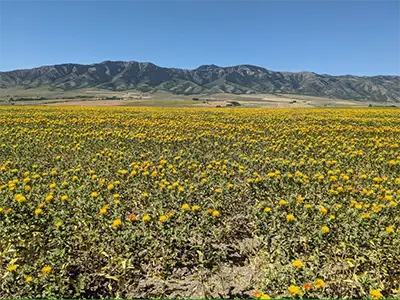 Maintains agriculture—Cache County is one of the most productive agricultural counties in the state of Utah. The 2022 U.S. Census of Agriculture shows that Cache Valley has just under 1,400 farms covering over 279,000 acres. The Cache County General Plan (2023) has designated this area of northern Utah to remain agricultural with the widely held credo popularized by many in Cache Valley, Let’s keep the city, city and the country, country. The consensus appears to advocate for density close to urban centers rather than suburban sprawl into our agricultural areas. Historically, farming has played an important role in economic viability and cultural identity of Cache County. This is a dry-farming operation and with so little water in Clarkston, the addition of residential subdivisions and/or commercial operations seems not a good use for this land.
Maintains wildlife habitat—The wildlife which occupies the adjacent mountains above Clarkston travel onto the cropland to forage on harvested crops. This includes elk and mule deer. Left over wheat plots attract these large game animals and provide them with much needed nutrients. Not only important for their feeding but critical to female does who return to the nearby mountains into secluded fawning territories to give birth. Ravsten also plants high-protein clover as a cover crop which provides double the benefit – soil health and wildlife forage. Other examples of wildlife found in this area include pheasant, sharp tail grouse, Hungarian partridge, coyotes, badgers, black-tailed jack rabbits, mourning doves and hawks.
UALT has applied for funding to NRCS, LeRay McAllister and the Cache County (through the Cache Open Space Advisory Committee). The government funding that is raised will be used to pay Ravsten for placing a conservation easement on his 242 acres of cropland. This would be a perpetual conservation easement on privately-owned agricultural land.